
CALL NOW
(281) 367-4660

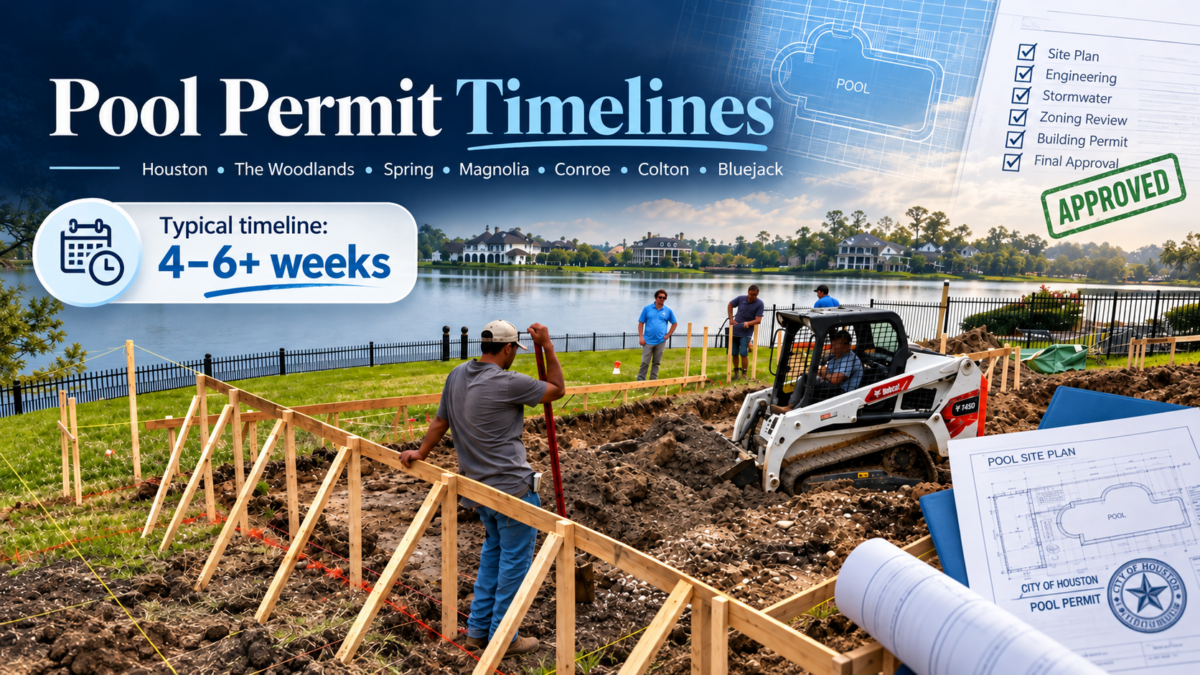
At Texas Pools, we tell our customers to plan on a minimum of 4–6 weeks for the permitting and approval process before construction begins. Sometimes the process moves faster. Sometimes it takes longer.
At Texas Pools, we tell our customers to plan on a minimum of 4–6 weeks for the permitting and approval process before construction begins.
Sometimes the process moves faster. Sometimes it takes longer.
The reason is that obtaining approval for a swimming pool is rarely as simple as submitting one application to one city department. Depending on where your property is located, your project may require approval from a city, county, homeowners association, Municipal Utility District (MUD), The Woodlands Township, or a combination of several different authorities.
In fact, one of the most important things homeowners should understand is this:
The city shown on your mailing address does not necessarily determine who has authority over your swimming pool project.
That is particularly important in areas such as The Woodlands, Spring, Magnolia, and Conroe.
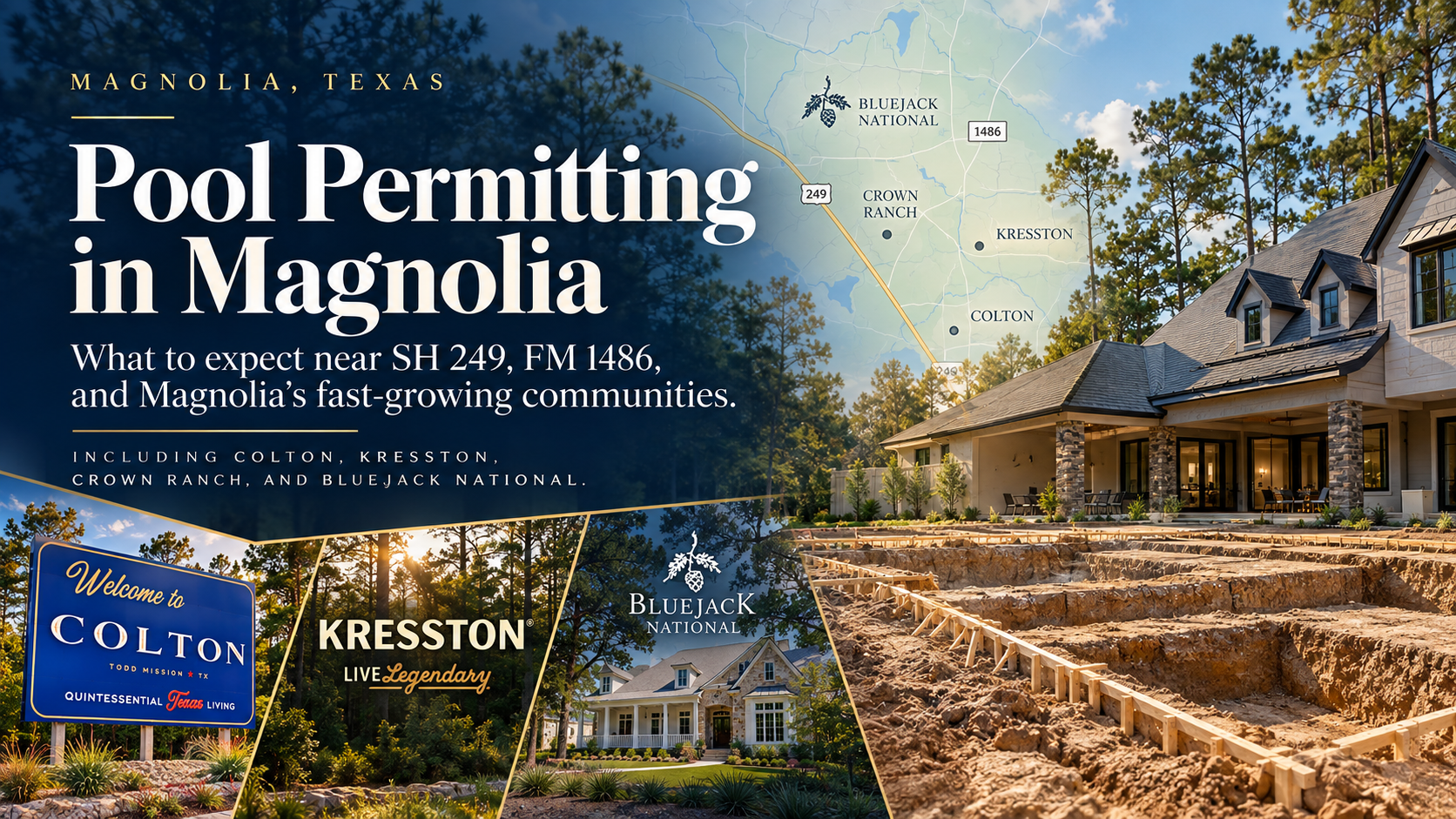
It is also becoming increasingly important in fast-growing areas around Magnolia and FM 1486, including communities such as Colton, Bluejack, Kresston, and Crown Ranch. A Magnolia-area mailing address does not always mean the property falls under the City of Magnolia’s permitting authority, so confirming the actual jurisdiction early is especially important in these developing areas.
Texas Pools has been building custom swimming pools in the Houston area since 1980, and the team member who oversees our permitting process has been handling permitting for Texas Pools for more than 35 years.
That experience matters.
Knowing which jurisdiction has authority, what documentation it requires, and what issues are likely to create questions during plan review can make a tremendous difference in moving a project through the approval process efficiently.
Although every jurisdiction is different, most swimming pool projects follow a similar sequence.
The builder first determines the property’s actual permitting jurisdiction. The property survey is then reviewed for easements, building lines, utilities, drainage issues, floodplain considerations, septic systems, and other restrictions.
After the pool design and site plan are completed, HOA or Township approvals may need to be obtained before the permit package is submitted.
The permitting authority then reviews the plans and may request revisions or additional information before approving construction.
Once construction begins, additional inspections are typically required for electrical, plumbing, pool barriers, equipment, and the completed project.
Because a published review time is only part of the process.
There may also be HOA review, Township approval, county requirements, engineering questions, plan revisions, utility approvals, floodplain considerations, or other project-specific requirements.
Rather than giving homeowners an unrealistically short timeline, we believe it is better to establish an appropriate expectation from the beginning.
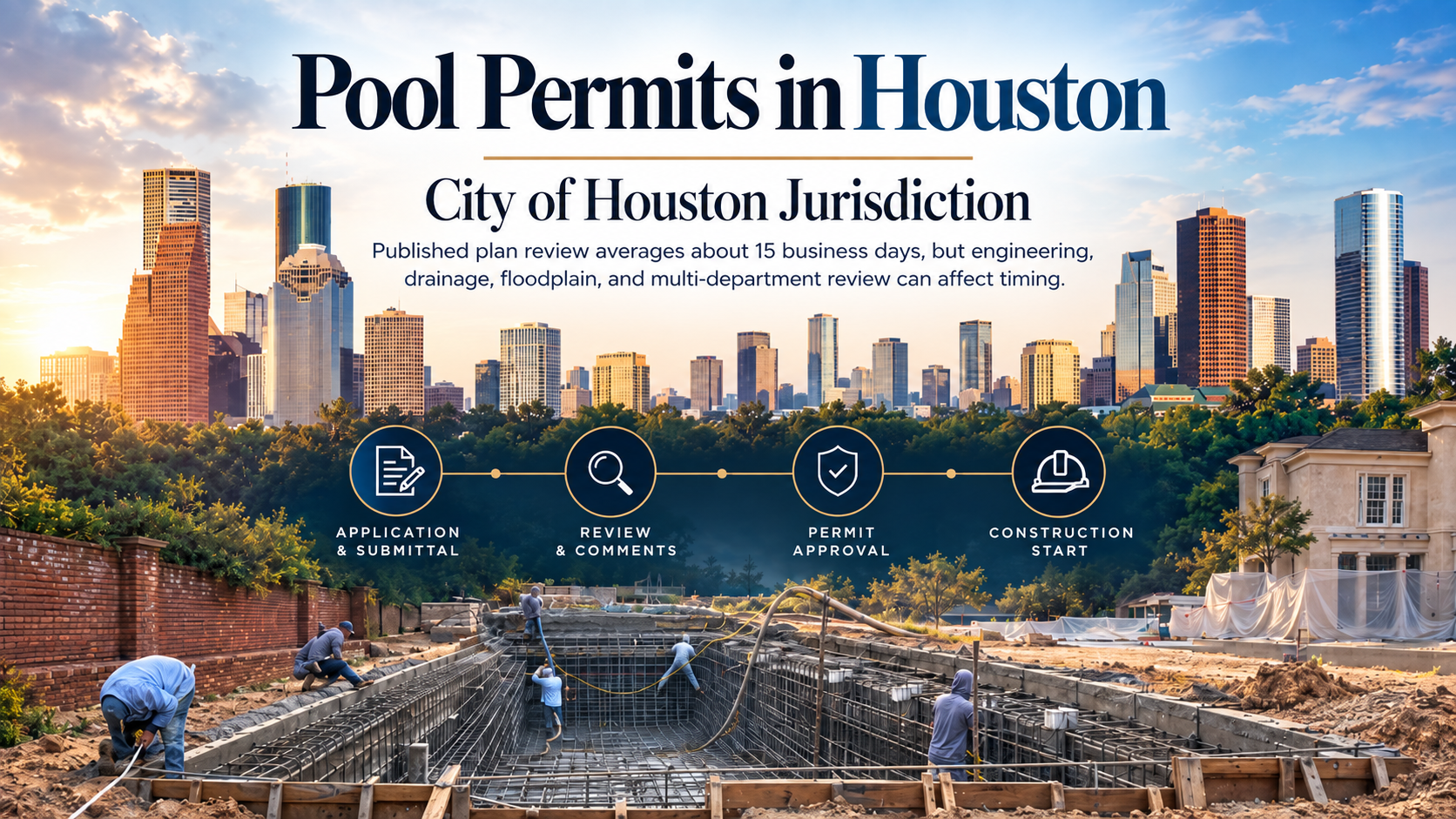
Swimming pools located within the City of Houston require a City of Houston building permit , electronic plan review, and inspections.
Depending upon the project, the review may involve electrical, plumbing, gas, structural, drainage, floodplain, utility, forestry, and other City departments.
The Houston Permitting Center currently publishes an average processing time of approximately 15 business days, but that should be viewed as a planning estimate rather than a guaranteed approval date.
That is also why a builder’s overall permitting timeline may be longer than the City’s published plan-review time.
Some of the more important issues include:
Houston projects can become more time-consuming because several departments may have to review portions of the same project.
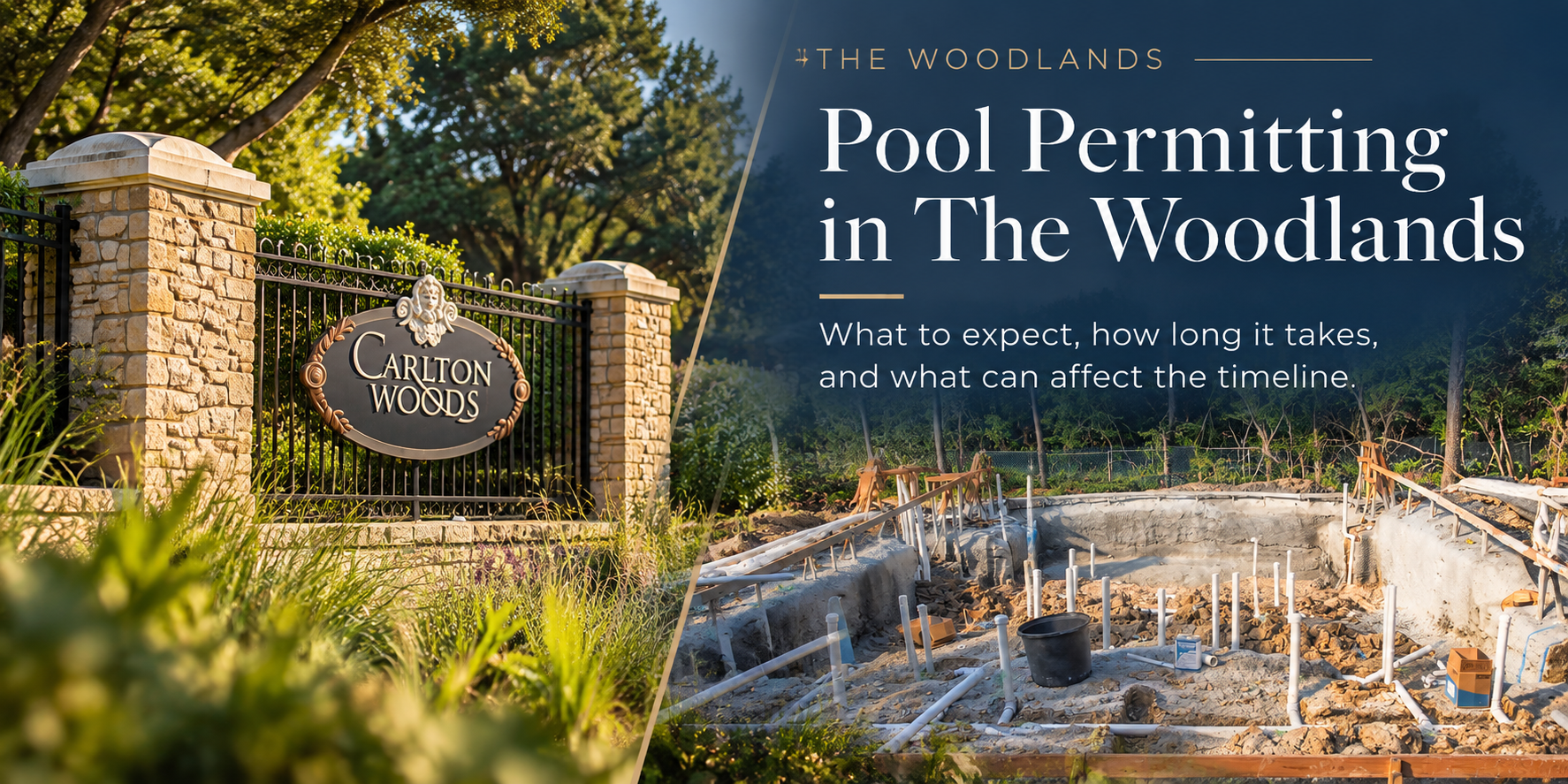
The Woodlands is not an incorporated city.
Swimming pool projects generally require approval through The Woodlands Township Covenant Administration , along with applicable Harris County or Montgomery County permitting requirements.
That distinction is important because homeowners sometimes assume there is a “City of The Woodlands” building department. There isn’t.
The Township’s review can include the pool and spa, decking, equipment, drainage, fencing, landscaping, tree removal, easements, setbacks, and the amount of hard surface being added to the property.
A drainage plan is also required, and proposed improvements must be marked on the property for the Township’s site visit.
Among the more important issues are:
Properties in portions of Grogan’s Forest that fall within the City of Shenandoah can present another layer of complexity because they may be subject to dual authority and concurrent review.
This is a good example of why accurately identifying jurisdiction before submitting plans is so important.
No.
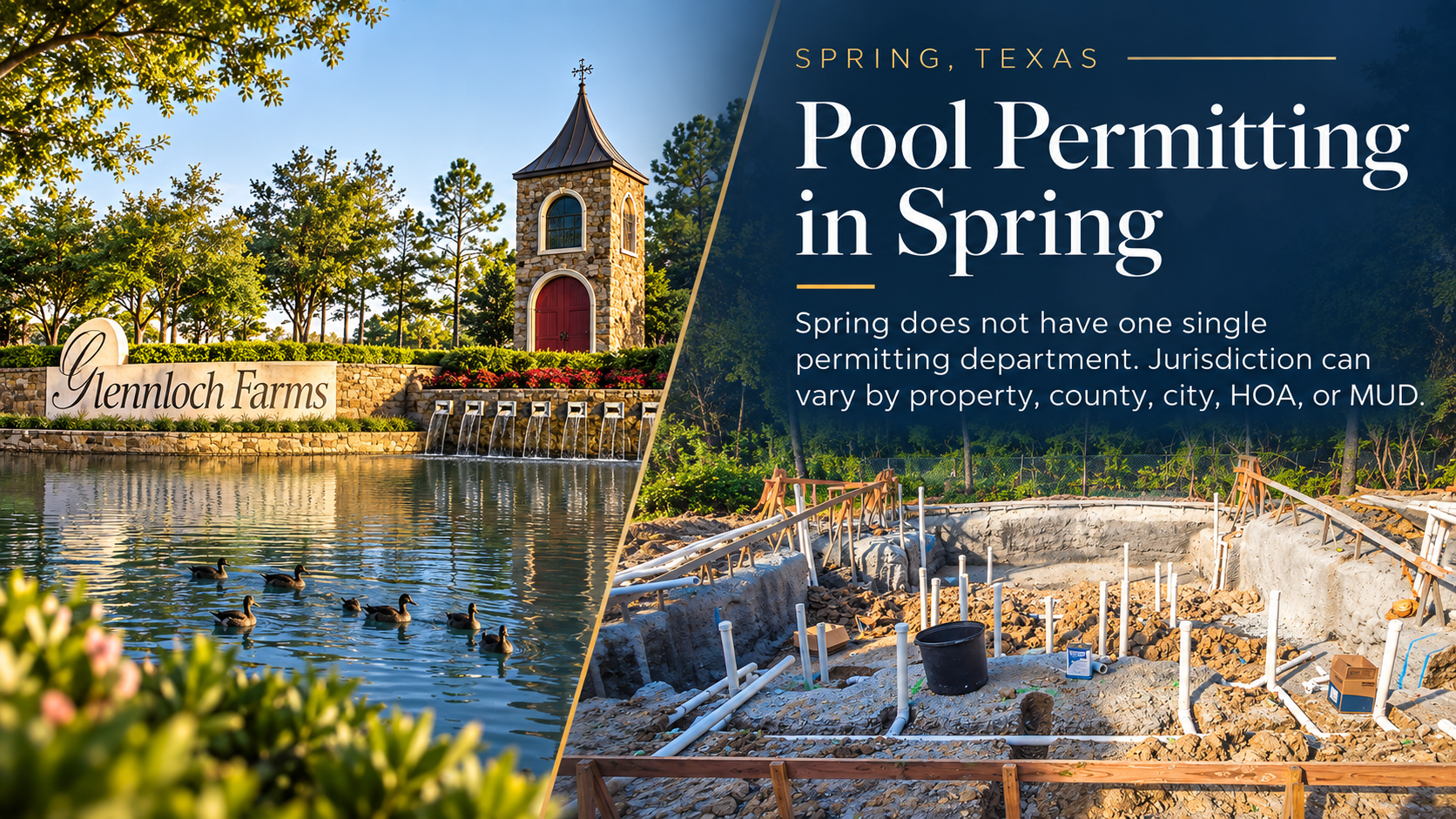
There is no single “City of Spring” permitting department.
What happens next depends entirely upon where the property is actually located.
Many Spring addresses are located in unincorporated Harris County, while others may fall within Montgomery County, the City of Houston, The Woodlands Township, or another municipality.
An HOA or MUD may also have approval requirements.
The biggest issue is often jurisdiction.
A homeowner may have “Spring, Texas” in the mailing address but actually be subject to a completely different permitting authority.
Other important considerations include:
For a Spring pool project, confirming the jurisdiction before completing the permit package is especially important.
Yes, for properties located inside the City of Magnolia .
The pool contractor must also be registered with the City.
Magnolia requires a detailed site plan showing structures, setbacks, easements, rights-of-way, the electrical panel, overhead electrical lines, and water, sewer, and gas utilities.
Separate electrical and plumbing permit applications accompany the swimming pool application.
The City currently asks applicants to allow approximately 10 business days for plan approval. Again, that refers to plan review and should not automatically be interpreted as the entire pre-construction approval timeline.
This is also an increasingly important conversation in the greater Magnolia growth corridor near SH 249 / Aggie Expressway and FM 1486, where communities such as Colton, Bluejack, Kresston, and Crown Ranch are attracting more custom-home construction and high-end backyard projects.
In many of these fast-growing areas, homeowners may casually refer to the location as Magnolia, even though the actual permitting authority may depend on whether the property is inside the City of Magnolia or in unincorporated Montgomery County.
Some issues particularly worth watching include:
That is one reason permitting experience matters so much in this part of the market. In areas like Colton, Bluejack, and Kresston, a builder should understand not only the pool design itself, but also the broader development context, site conditions, and approval path before the permit package is submitted.
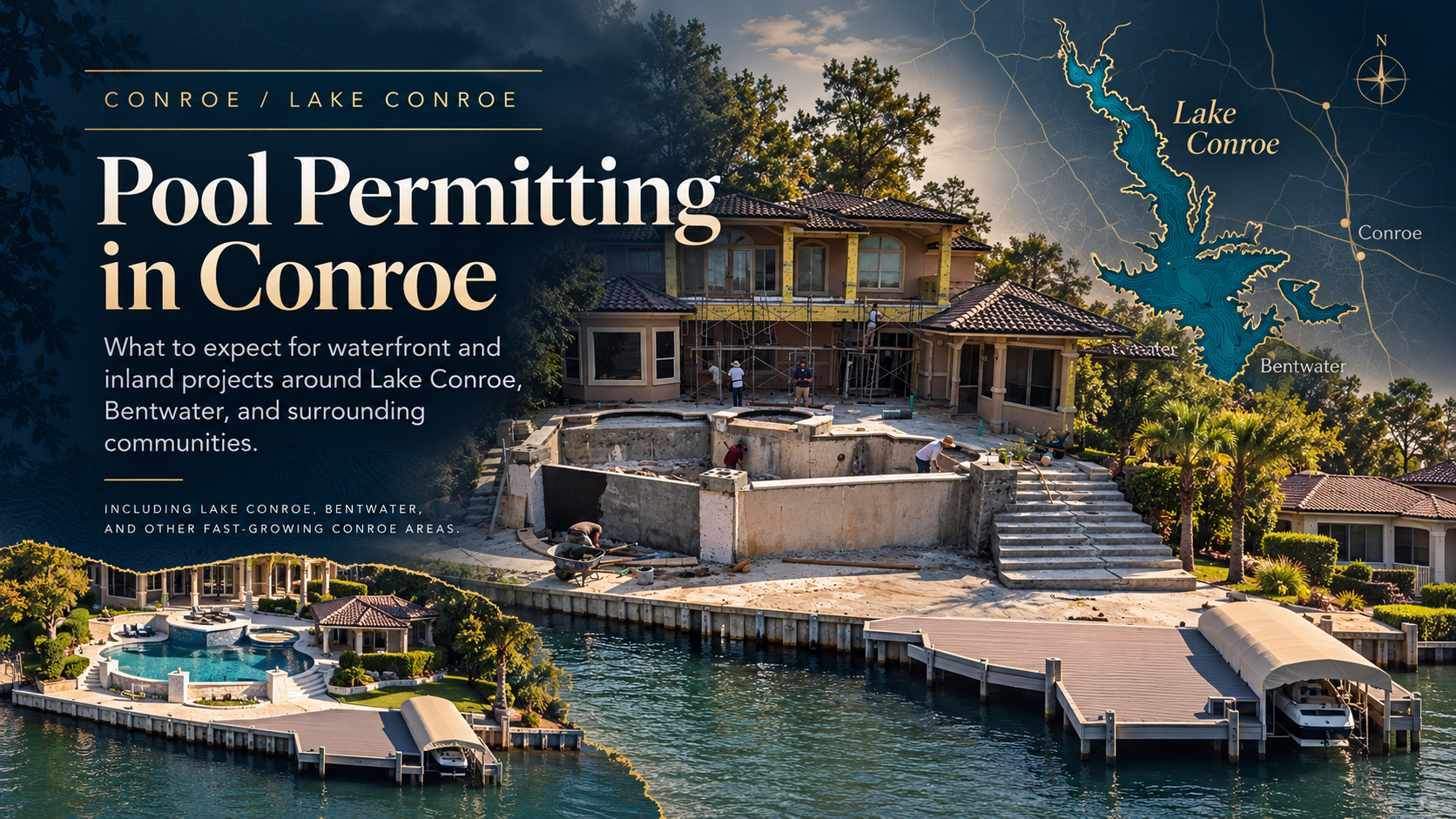
For property located inside Conroe city limits, pool permits and inspection requests are submitted through the City’s permitting system and reviewed under applicable building, electrical, plumbing, and swimming-pool codes.
Conroe also has specific inspection scheduling requirements.
Inspection requests must currently be submitted by 4:00 p.m. for the following business day, and same-day inspections are not available. Inspectors must also be able to access the property.
Important issues include:
Another important distinction: a Conroe mailing address does not necessarily mean the property is inside Conroe city limits. Some properties instead fall under Montgomery County jurisdiction.
This is an increasingly important consideration for properties surrounding The Woodlands, Spring, Magnolia, and Conroe.
Effective October 1, 2025, Montgomery County requires a development permit for development unless the project qualifies for an applicable exemption.
County review can involve stormwater documentation, utility letters, septic information, drainage approval, floodplain information, and a full-property site plan. Properties close to a floodplain or floodway may require additional review.
Some of the most significant issues include:
It is easy to assume that permitting delays happen because an application is simply sitting on someone’s desk.
Sometimes review volume certainly affects timing, but many delays have a more specific cause.
Pool permitting is rarely delayed by one mysterious government obstacle.
More often, additional time is created because the property’s jurisdiction was misunderstood, required information is missing, or the proposed pool conflicts with an easement, drainage route, floodplain requirement, septic system, tree restriction, utility requirement, or neighborhood standard.
An experienced pool builder should be looking for those issues before the permit application is submitted—and ideally before the final pool design is completed.
Permitting isn’t the most exciting part of building a swimming pool.
But it is one of the areas where experience behind the scenes can prevent significant frustration later.
Texas Pools has been building swimming pools in the Houston area since 1980.
Even more importantly, the team member responsible for managing our permitting process has been handling permits for Texas Pools for more than 35 years.
That means we aren’t learning a jurisdiction for the first time when we submit your project.
Our team has spent decades dealing with the cities, counties, Township requirements, HOAs, MUDs, surveys, easements, drainage requirements, plan revisions, and inspections that are part of building swimming pools throughout this area.
We cannot control how quickly a reviewing authority processes an application.
What we can control is how thoroughly we prepare for that review.
That means identifying the correct jurisdiction, looking for potential property issues early, submitting the appropriate documentation, responding to requested revisions, coordinating required approvals, and helping move the project toward construction.
Texas Pools recommends planning for a minimum of 4–6 weeks for permitting and approvals.
A straightforward project may move through the process more quickly, while a property involving multiple jurisdictions, HOA review, drainage, floodplain conditions, septic systems, engineering, variances, or other special circumstances can take longer.
No reputable builder can control the review time of a city, county, HOA, MUD, Township, or other government authority.
Published review times are useful planning tools, but they should not be treated as guaranteed permit dates.
Not necessarily.
This is especially important for properties with The Woodlands, Spring, Magnolia, or Conroe mailing addresses.
The property’s actual location—not simply the mailing address— determines which governmental entities have jurisdiction.
Many communities do require HOA or Township approval, and in some situations that approval must be obtained before or coordinated with governmental permitting.
Yes.
Pools, decking, equipment, retaining structures, and other improvements may be restricted from certain utility or drainage easements. That is why reviewing the survey early in the design process is so important.
Absolutely.
Depending on the property, additional drainage information, elevation data, engineering, or floodplain review may be required.
It can.
Additional structures may require separate permits or additional plan review, depending upon the jurisdiction and scope of the project.
It depends on the property’s actual location and jurisdiction. Communities such as Colton, Bluejack, Kresston, and Crown Ranch are part of the rapidly growing Magnolia-area corridor, but a Magnolia mailing address does not necessarily mean the City of Magnolia is the permitting authority.
Properties outside Magnolia city limits may instead fall under Montgomery County requirements, along with applicable HOA, MUD, utility, drainage, or other development approvals. The jurisdiction should be confirmed before the pool permit package is prepared.
One of the biggest advantages of working with an experienced custom pool builder is understanding that the project doesn’t begin with excavation.
It begins with understanding the property.
Before a pool can be built successfully, someone needs to understand where it can legally and practically be placed, what authorities govern the property, what approvals are required, and what conditions could affect the design.
The beautiful pool is the part everyone eventually sees.
The decades of permitting and construction experience that helped get it there usually happen behind the scenes.
At Texas Pools, we’ve been navigating that process since 1980.
And when you’re making a major investment in your backyard, that experience matters.
Don’t let jurisdiction confusion or permitting delays derail your pool project before it starts. Schedule a consultation with Texas Pools, and we’ll help you understand your property, your permitting authority, and your timeline, right from the start.
Schedule a Consultation©2026 Texas Pools. All Rights Reserved | Privacy Policy | Terms and Conditions | Site Map

By submitting your phone number, you agree to receive marketing text messages from Texas Pools. Message frequency varies. Message and data rates may apply. Text HELP for Support. Text STOP to opt-out. View our Terms of Service and Privacy Policy.
By submitting your phone number, you agree to receive marketing text messages from Texas Pools. Message frequency varies. Message and data rates may apply. Text HELP for Support. Text STOP to opt-out. View our Terms of Service and Privacy Policy.
By submitting your phone number, you agree to receive marketing text messages from Texas Pools. Message frequency varies. Message and data rates may apply. Text HELP for Support. Text STOP to opt-out. View our Terms of Service and Privacy Policy.
By submitting your phone number, you agree to receive marketing text messages from Texas Pools. Message frequency varies. Message and data rates may apply. Text HELP for Support. Text STOP to opt-out. View our Terms of Service and Privacy Policy.
By submitting your phone number, you agree to receive marketing text messages from Texas Pools. Message frequency varies. Message and data rates may apply. Text HELP for Support. Text STOP to opt-out. View our Terms of Service and Privacy Policy.
By submitting your phone number, you agree to receive marketing text messages from Texas Pools. Message frequency varies. Message and data rates may apply. Text HELP for Support. Text STOP to opt-out. View our Terms of Service and Privacy Policy.
By submitting your phone number, you agree to receive marketing text messages from Texas Pools. Message frequency varies. Message and data rates may apply. Text HELP for Support. Text STOP to opt-out. View our Terms of Service and Privacy Policy.
By submitting your phone number, you agree to receive marketing text messages from Texas Pools. Message frequency varies. Message and data rates may apply. Text HELP for Support. Text STOP to opt-out. View our Terms of Service and Privacy Policy.
By submitting your phone number, you agree to receive marketing text messages from Texas Pools. Message frequency varies. Message and data rates may apply. Text HELP for Support. Text STOP to opt-out. View our Terms of Service and Privacy Policy.
By submitting your phone number, you agree to receive marketing text messages from Texas Pools. Message frequency varies. Message and data rates may apply. Text HELP for Support. Text STOP to opt-out. View our Terms of Service and Privacy Policy.
By submitting your phone number, you agree to receive marketing text messages from Texas Pools. Message frequency varies. Message and data rates may apply. Text HELP for Support. Text STOP to opt-out. View our Terms of Service and Privacy Policy.
By submitting your phone number, you agree to receive marketing text messages from Texas Pools. Message frequency varies. Message and data rates may apply. Text HELP for Support. Text STOP to opt-out. View our Terms of Service and Privacy Policy.
By submitting your phone number, you agree to receive marketing text messages from Texas Pools. Message frequency varies. Message and data rates may apply. Text HELP for Support. Text STOP to opt-out. View our Terms of Service and Privacy Policy.
By submitting your phone number, you agree to receive marketing text messages from Texas Pools. Message frequency varies. Message and data rates may apply. Text HELP for Support. Text STOP to opt-out. View our Terms of Service and Privacy Policy.
By submitting your phone number, you agree to receive marketing text messages from Texas Pools. Message frequency varies. Message and data rates may apply. Text HELP for Support. Text STOP to opt-out. View our Terms of Service and Privacy Policy.
By submitting your phone number, you agree to receive marketing text messages from Texas Pools. Message frequency varies. Message and data rates may apply. Text HELP for Support. Text STOP to opt-out. View our Terms of Service and Privacy Policy.